
7 posts tagged with "Academic Research"

Academic research tools and paper discovery

View All Tags

OpenAlex Literature Review Workflows with AI

· 5 min read
MCPBundles

TL;DR

  • The OpenAlex MCP server connects your agent to OpenAlex — an open catalog of the global research system — after you add the server in MCPBundles.
  • OpenAlex reported 477 million indexed works in its Q1 2026 update (OpenAlex blog), with metadata under a CC0 license anyone can reuse.
  • Built for researchers and review leads who need topic discovery, single-paper lookups, and citation expansion in chat — not another closed subscription database.

Your PI asks for "everything on retrieval-augmented evaluation since 2022" by Thursday. You've got twelve tabs open, three half-finished Zotero imports, and a spreadsheet where column B is supposed to be DOIs but half the rows are blank. The bottleneck isn't finding one good paper — it's holding the map in your head while you chase who cited whom.

OpenAlex exists to be that map in the open. We wired it into MCPBundles so an agent can search, open metadata, and walk citations without you becoming the human middleware between discovery tools.

Semantic Scholar Research Workflows with AI

· 5 min read
MCPBundles

TL;DR

  • The Semantic Scholar MCP server connects your agent to Semantic Scholar — Allen Institute for AI's free research discovery service — after you add the server in MCPBundles.
  • Semantic Scholar's product pages describe search across 214 million papers from all fields of science, with citation links and recommended reads built into the graph.
  • Built for researchers and R&D teams who need paper discovery, author lookup, and reading-list expansion without exporting CSVs from yet another web UI.

It's 10 p.m. and your related-work section still says "TBD." You know three anchor papers cold, but you're not sure which follow-on studies actually matter — and you're definitely not opening forty browser tabs to compare citation counts by hand.

Semantic Scholar was built for that kind of overload: search at scale, citation context, author profiles, and recommendations on top of a graph that already connects papers to papers. MCPBundles puts the same corpus one prompt away from the agent you already use for drafting.

Zotero with AI: Run Your Research Library From Chat

· 8 min read
MCPBundles

TL;DR

  • The Zotero MCP server lets an AI assistant work with your library the way you do — search saved papers, read citation details and notes, download PDFs, build collections, and tidy missing fields.
  • Connect your Zotero account for full read and edit, or read straight from the Zotero app on your computer when you want a fast, private look without syncing anything new.
  • It is for researchers, PhD students, and literature-review teams who are tired of clicking through a reference manager one paper at a time — can I actually move this review forward?, not can I search the web?

If you keep your reading in Zotero, most "AI for research" demos miss the point. They search the open web, summarize a paper you pasted in, and stop. The work that actually eats your week lives somewhere else: in the few hundred references already sitting in your library, half of them missing a year or a clean author list, a third with no PDF attached.

Mendeley with AI: Literature Reviews Need Reference Workflows, Not Just Search

· 6 min read
MCPBundles

Most "AI for research papers" demos stop at search: find a paper, summarize it, maybe extract a citation. Useful for a screenshot, useless for a real review.

Picture this instead. You have 240 papers saved in Mendeley for a RAG-evaluation review. Forty are missing DOIs. Eighteen have a citation record but no attached PDF. Six are duplicates from earlier exploratory searches. Your shared group library has 30 newer papers your collaborator added last week that you have not seen yet. None of that shows up in a "search the web" demo.

We rebuilt the Mendeley MCP server around that mess. An agent now works with your library as a library — saved papers, missing metadata, PDF files, folders, annotations, groups, trash, and all.

ClinicalTrials.gov API: Search Studies, Conditions, Sponsors, and Trial Details with AI

· 4 min read
MCPBundles

TL;DR

  • Query 586,479 registered studies on ClinicalTrials.gov live — not from a stale local mirror — through the Clinical Trials MCP server.
  • Filter by condition, intervention, phase, recruiting status, sponsor, location, and posted results without building Lucene query strings; study detail returns eligibility, arms, outcomes, and site contacts in structured fields.
  • Built for biotech landscape scans, clinical ops comparisons, patient-advocacy briefings, and research tools where the job is turn trial records into an answer, not navigate the registry one click at a time.

If you work in clinical research, biotech strategy, patient advocacy, or healthcare investing, the hard part is not knowing that ClinicalTrials.gov exists. The hard part is turning trial records into an answer you can use.

You may be trying to understand which sponsors are active in a disease area, whether a competitor has moved from phase 2 into phase 3, how strict the eligibility criteria are for a class of studies, or whether there are recruiting trials a patient advocacy team should know about. The raw registry has the data. Your actual job is to read across it quickly and explain what it means.

The Clinical Trials MCP server gives your AI agent a structured way to search studies, pull trial details, and summarize the result in the same conversation where the research question started.

Rating MCP Server Quality: How We Score Tools, Skills & Annotations

· 11 min read
MCPBundles

Rating MCP Server Quality

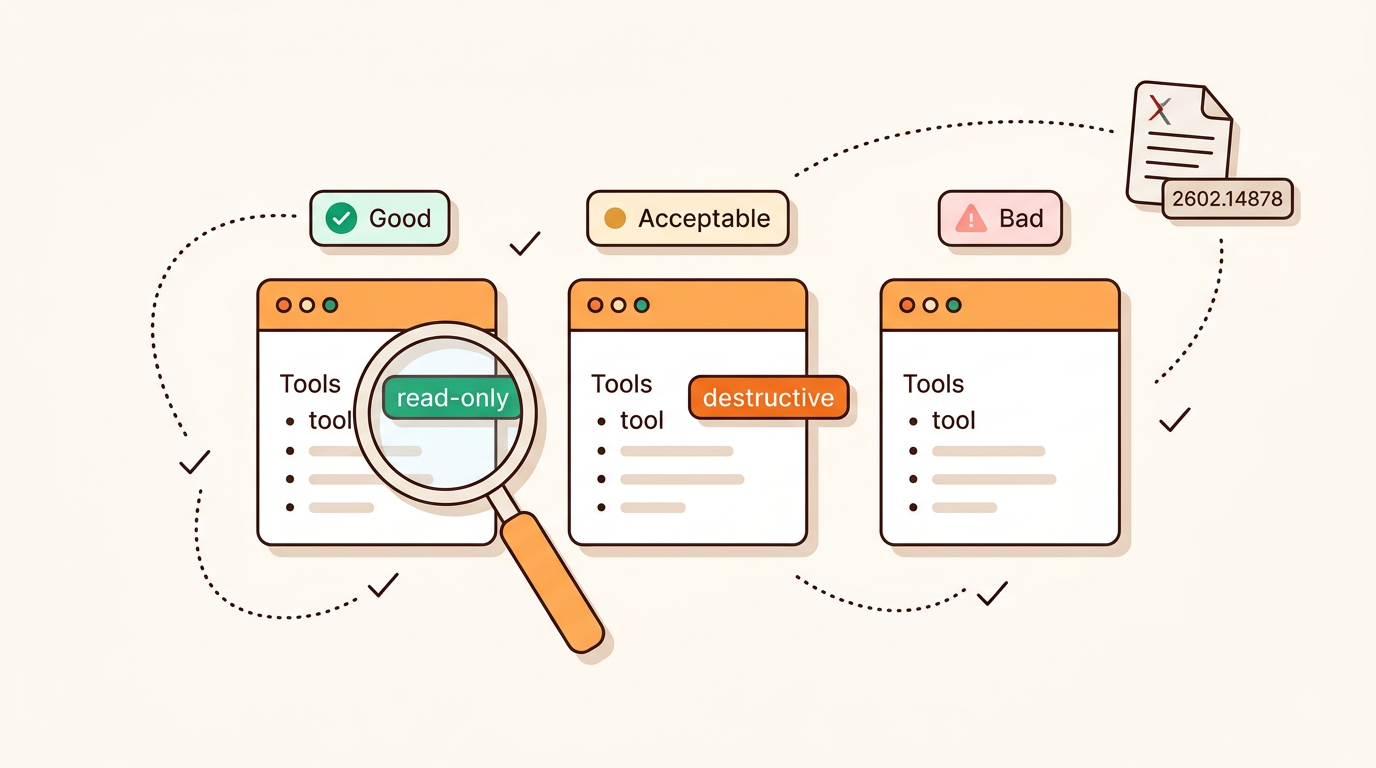
The average MCP tool description is bad. Two recent arXiv papers measured exactly how bad. 97.1% of analyzed tools carry at least one description smell. 73% of servers reuse the same display_name across multiple tools. In head-to-head selection between five functionally equivalent servers, the one with a clearer description gets picked 72% of the time vs a 20% baseline.

A 260% selection lift from prose alone is the headline. Descriptions aren't documentation; they're part of the agent-facing prompt, and a bad one quietly costs you every selection round your server is in. So we built a scorer.

MCPBundles now runs an LLM-as-judge rubric over every published server, covering tool descriptions, server-level skill content, and the structured MCP annotations that the runtime actually reads. The verdict shows up on the public listing page.

arXiv MCP Server: Search Papers, Read Abstracts & Full PDFs with AI (4 Tools, No Auth)

· 8 min read
MCPBundles

arXiv MCP Server

arXiv hosts more than 2.4 million papers across physics, mathematics, computer science, quantitative biology, and more. Researchers, ML engineers, and academics increasingly want the same thing from their AI stack: search papers, read abstracts, follow citations, track new work in a field, and go deeper into full text — all from the same chat thread.

arXiv does not ship an official MCP server. Community implementations exist on GitHub, but they vary in quality, transport, and maintenance. MCPBundles hosts a dedicated arXiv provider (arxiv) with 4 MCP tools backed by the official arXiv Atom API — no API key required, no self-hosting, no config files. Enable the bundle, connect your AI client, and start searching.